Where Should You Buy a Secondhand Yamaha Piano? 10 Things to Check Before You Decide
When you start looking for a secondhand Yamaha piano, you may find that the same model is offered at very different prices even though the pianos may look similar from the outside.
PNO-002
When you start looking for a secondhand Yamaha piano, you may find that the same model is offered at very different prices even though the pianos may look similar from the outside.
This naturally raises the question:
“Where should you buy a secondhand Yamaha piano?”
The answer may not simply be “the shop offering the lowest price.” An acoustic piano can remain in use for many decades.
The points to consider therefore range from the condition of the piano and the reconditioning process to the warranty, after-sales service, and the options available if you no longer wish to use the piano in the future.
Quick answer
Before buying a secondhand Yamaha piano, check its origin, internal condition, reconditioning process, warranty, after-sales service, total costs, and the options available if you no longer need the piano. Do not compare pianos only by model name or displayed price.
Churairat Reconditioning Standard — Summary
Churairat Music’s Japanese secondhand pianos go through a selection, inspection, reconditioning, and preparation process carried out by our own factory and team, so that each piano is ready for long-term use.
- Pianos with sound fundamental condition and structure are selected in Japan
- More than 50 points are inspected using the factory QC checklist
- Each piano is assessed and treated individually according to its actual condition
- Cleaning, adjustment, repair, or parts replacement is carried out where necessary
- Both the external cabinet and internal mechanism are prepared
- Main service areas: Bangkok, Chiang Mai, Phuket, and Khon Kaen, with a 5-year warranty and three complimentary tunings, subject to company conditions
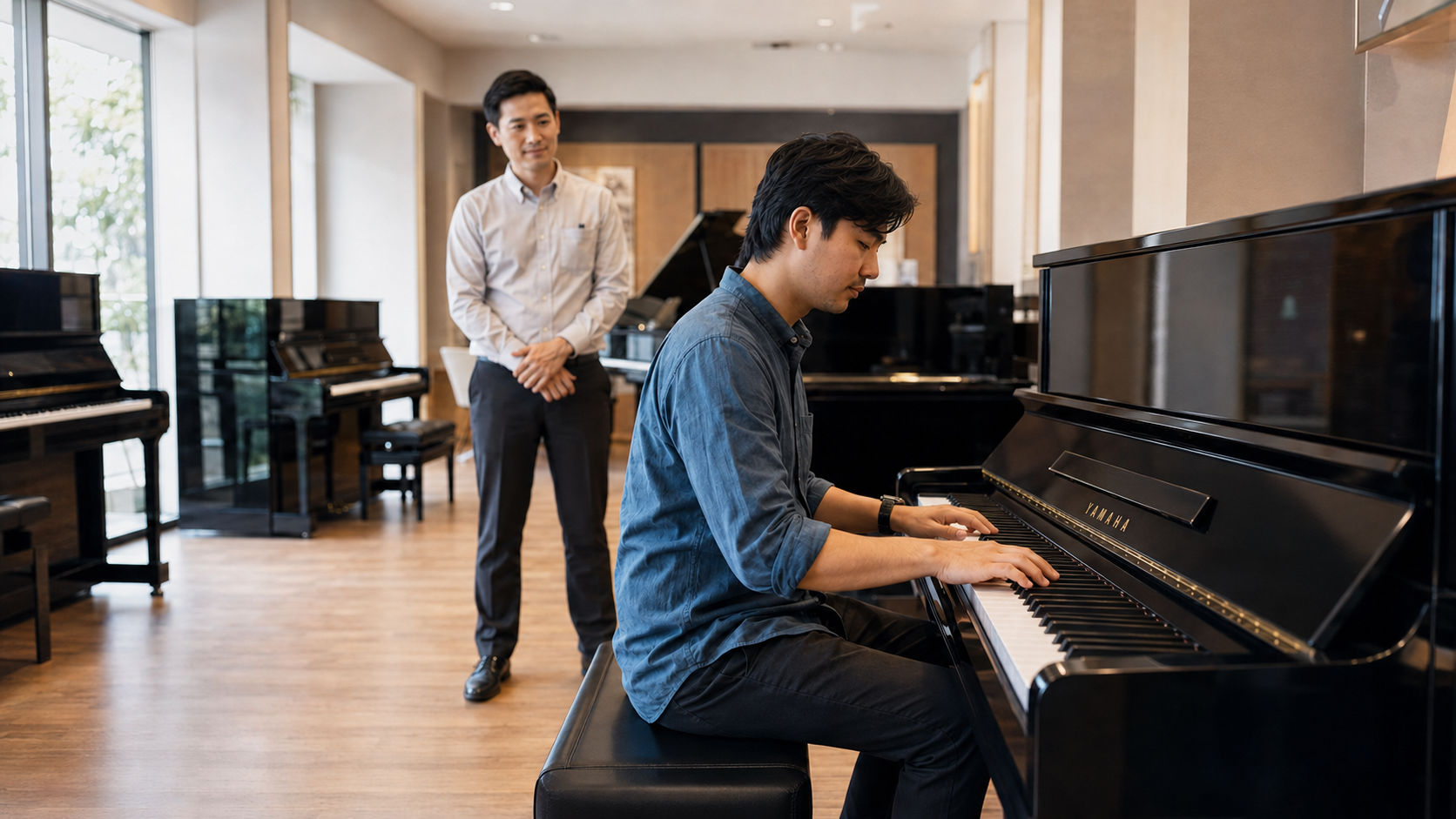
The following are 10 important points to check before buying a secondhand Yamaha piano.
1. Where does the piano come from?
Secondhand Yamaha pianos in Thailand come from various sources. They may have originally been imported as new pianos from Indonesia, China, or Japan, or they may be used pianos imported from Japan.
The term ‘Japanese secondhand piano’ tends to be more widely accepted by customers, but it does not mean that every secondhand piano from Japan has the same quality.
Each piano may differ in age, previous use, former environment, and maintenance history.
2. Has the piano genuinely been reconditioned?
Reconditioning a secondhand piano should not mean only cleaning, polishing the cabinet, or improving its outward appearance.
The key point is the condition and operation of the entire piano, especially its internal mechanism.
Before buying, ask:
- Who inspected the piano?
- Is there a technician with specialist piano knowledge?
- Was the internal mechanism inspected?
- What adjustments or parts replacements were carried out where necessary?
- Does the seller have its own factory or operating facility?
The term ‘Reconditioned Piano’ may be used by many sellers, but their processes and standards can differ.
Buyers should therefore ask whether the seller uses a systematic piano checklist and can explain which parts of each piano were inspected before it was offered for sale.
3. Do not judge by outward appearance alone
A piano that looks beautiful on the outside does not necessarily have an internal mechanism in perfect condition.
Conversely, a piano may have minor age-related marks while its structure and internal mechanism remain in good condition.
For most buyers, a visual inspection alone may not be enough.
What cannot be seen from the outside may matter more to playing quality and long-term use than what is immediately visible.
4. The same Yamaha model does not mean the same condition or quality
For example, Yamaha U1 or U3 pianos of the same model can still be sold at different prices.
The price of a secondhand piano is not determined by the model name alone. Other factors include:
- Age and serial number
- Previous usage condition
- Condition of the structure and internal mechanism
- Quality of the reconditioning
- Preparation before delivery
- Warranty
- After-sales service
Therefore, when comparing pianos from different sellers, do not compare only:
“Which shop has the cheaper Yamaha U3?”
Instead, compare:
“At the price we pay, what condition is the piano in, and what care and service are included?”
5. Try the tone and key touch before deciding
Even among Yamaha pianos of the same model, each instrument may have a different tonal character and playing touch.
Whenever possible, try the actual piano before making a decision.
Beginners who cannot yet assess a piano themselves may ask a piano teacher or an experienced player to help, or choose a seller who can recommend a piano according to:
- Learning level
- Type of use
- Space in the home
- Budget
Choosing the right piano does not always mean choosing the most expensive model.
6. What does the warranty cover, and for how long?
Before buying, ask clearly:
What is covered? For how long? And if a problem occurs, who will provide the service?
A good warranty should have clear conditions, and the seller should have a genuine ability to provide after-sales support.
An acoustic piano has many mechanical components and a long working life.
7. Is tuning and an after-sales technical team available?
Buying a piano does not end when the piano is delivered to your home.
A piano requires long-term care, especially tuning and inspection or adjustment when necessary.
Ask the seller:
- Does the seller have its own piano technicians?
- Is after-sales tuning provided?
- Can the team provide service in the area where the customer lives?
- If a future problem occurs, who will take care of it?
After-sales service is therefore part of the piano’s value and should be considered before purchase.
8. What is included in the advertised price?
Two pianos with different selling prices may not be directly comparable by their price tags alone.
Check what the price includes, such as:
- Delivery
- Moving up or down floors
- Piano tuning
- Warranty
- Piano bench
- Included accessories
- After-sales service
- Other privileges
A piano with a lower initial purchase price may sometimes involve additional expenses later.
Consider the total value received, not only the purchase price on the first day.
9. What happens if you no longer need the piano one day?
This is a question many people do not consider while choosing a piano.
In the future, circumstances may change:
- A child stops learning piano
- You want to upgrade to a larger model
- You move home
- There is no longer enough space
- You want to sell the piano
Selling a piano yourself may take time. It may sell below the expected price, take several months to sell, or not sell at all.
Therefore, before buying, ask from the very first day:
“If we no longer need the piano in the future, what options can the seller provide?”
10. Can the seller take care of your piano over the long term?
An acoustic piano can remain with a family for many decades.
Choosing the seller is therefore as important as choosing the piano brand and model.
Consider all of the following:
Experience, expertise, factory, technical team, piano-preparation process, warranty, and ability to provide after-sales service.
These factors can make a difference throughout the time you own the piano.
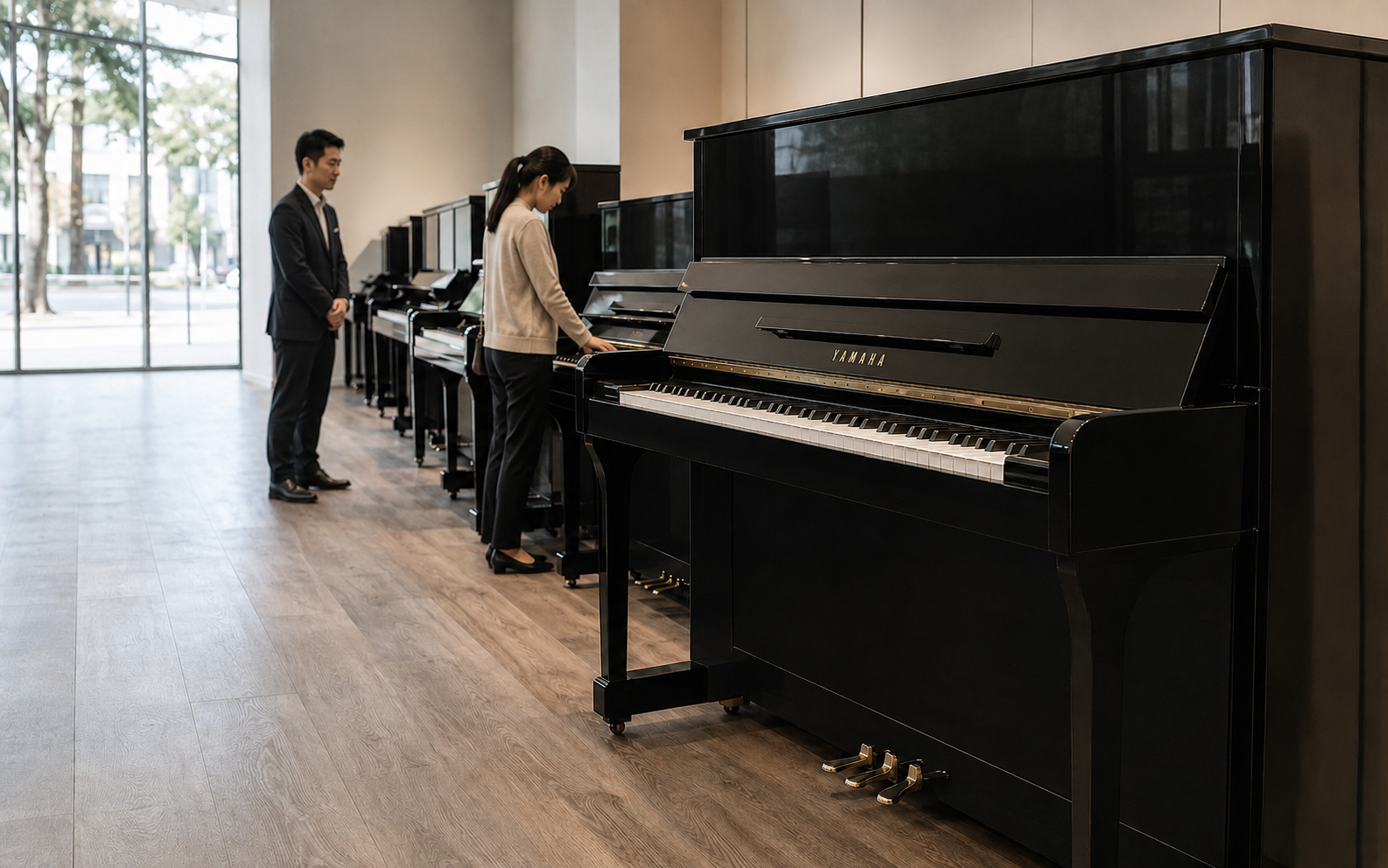
How are Churairat secondhand Yamaha pianos different?
How are Churairat secondhand Yamaha pianos different?
At Churairat Music, the preparation of a secondhand piano does not begin when the piano arrives in Thailand. It begins with selecting the piano in Japan.
Our own team selects the pianos, focusing on instruments with a good fundamental condition and sound structure that are suitable for reconditioning into quality pianos ready for long-term use.
We do not focus on buying the cheapest pianos in Japan. Even if a piano can be purchased cheaply, we do not offer it to customers if its underlying condition is poor or it cannot be reconditioned to our required standard.
Churairat Music therefore places importance on “selecting a piano with a good foundation from the beginning.”
The piano is then imported into Thailand and enters the inspection and reconditioning process at the Churairat factory, carried out by our own team.
We do not aim to compete by offering the cheapest piano in the market.
Instead, we focus on:
Piano quality, readiness for use, and long-term customer care
What the customer receives is therefore more than simply one piano.
Churairat Reconditioning Standard
Churairat Music’s Japanese secondhand pianos go through the Churairat Reconditioning Standard, our approach to selecting, inspecting, reconditioning, and preparing pianos through our own factory and technical team.
Piano selection in Japan
The process begins with piano selection in Japan. Our team focuses on pianos with a good fundamental condition and sound structure, including cabinets and exterior finishes that remain in good condition, are not excessively worn, and are suitable for the Churairat reconditioning process.
We do not aim to select the cheapest piano. If its basic condition cannot be reconditioned to our required quality standard, it is not a piano we want to offer to our customers.
More than 50 QC inspection points
When the piano arrives at our factory in Thailand, each instrument goes through a factory QC Checklist with more than 50 inspection points. The inspection covers important areas including the Action, Hammers, Dampers, Keyboard, Tuning Pins, Strings, Frame, Soundboard, Back Structure, Pedals, and other components included in the factory checklist.
Individual inspection and preparation
Each piano is inspected individually because the condition and required work differ from one used piano to another. It is then cleaned, adjusted, repaired, or fitted with replacement parts where necessary and according to company standards.
External cabinet and internal mechanism
Externally, the cabinet is inspected, cleaned, detailed, and its surface or finish is cared for according to the condition and needs of each piano to preserve and improve its appearance.
At the same time, the internal system is inspected and reconditioned so that the mechanism and components are complete and ready for use in accordance with company standards.
The principle behind the standard
Our approach is not to take a worn piano and simply make it look new. It is to select a good piano from the beginning and then care for and recondition it thoroughly, both outside and inside.
This is why comparing secondhand Yamaha pianos from different sellers should involve more than the model name, year, or displayed price. Ask how the piano was selected and what inspection and reconditioning it has undergone.
5-year warranty with three complimentary tunings
For our main service areas—Bangkok, Chiang Mai, Phuket, and Khon Kaen—qualifying pianos receive a 5-year warranty and three complimentary tunings.
Piano care should not end on the delivery date. Having a technical team and reliable after-sales service is another important point to consider before buying.
Hydraulic adjustable piano bench
The piano comes with a hydraulic adjustable piano bench, allowing the player to adjust the height conveniently for their body and playing posture.
This is another detail Churairat Music considers important so that customers receive both a piano and equipment suitable for actual use.
Churairat Privilege Coupon — value that continues after purchase
Buying a piano from Churairat Music is also connected to the Churairat Privilege Coupon programme.
Under the programme conditions, customers who purchase participating products or use participating services may use the amount paid as discount entitlement toward participating products, with the total entitlement capped at the amount originally paid.
- Piano accessories
- Music books
- Musical instruments
- Other participating equipment and products
The Privilege Coupon is valid for one month from the payment date and cannot be combined with other promotions, subject to company conditions.
It is another benefit that allows the value of a purchase or service from Churairat Music to extend to other products.
Churairat Lifetime Buy Back Guarantee
If one day a customer no longer needs the piano, Churairat Music also provides the Churairat Lifetime Buy Back Guarantee.
The programme covers every acoustic piano at every price purchased from Churairat Music, including new pianos and Japanese reconditioned pianos from Yamaha, Kawai, and other brands. Digital pianos are excluded. Company terms and conditions apply.
Before deciding to buy a piano, customers therefore do not need to ask only:
“How much does it cost today?”
They can also think ahead to:
“What can I do if I no longer need the piano one day?”

Conclusion: Where should you buy a secondhand Yamaha piano?
No single seller is right for everyone, and the decision should not be based on price alone.
- Before buying, make sure you ask all of the following:
- Where does the piano come from? → How was it reconditioned? → Who will take care of it? → What is covered by the warranty? → Is after-sales service available? → And what options are available if the piano is no longer needed one day?
For a piano that may remain with a family for decades, the initial purchase price is only one part of its lifetime cost and value.
Frequently asked questions
Are secondhand Yamaha pianos from Japan good?
Yamaha pianos produced and sold for the Japanese domestic market are widely recognised for their manufacturing standards and piano quality.
For this reason, secondhand Yamaha pianos from Japan are among the options that attract buyers in many countries.
However, the phrase ‘secondhand piano from Japan’ alone does not mean that every piano is in equally good condition.
Each piano may differ in age, usage history, former environment, and maintenance.
A secondhand Yamaha from Japan can therefore be a worthwhile choice if the individual piano has a good fundamental condition and sound structure and has been properly selected, inspected, and reconditioned.
Each piano should be considered individually rather than judged only by the phrase ‘imported from Japan.’
Should I choose a Yamaha U1 or U3?
It depends on the available space, budget, playing level, and desired tonal character. Whenever possible, try and compare the pianos before deciding.
Can an older secondhand piano still perform well?
Age alone cannot fully indicate a piano’s condition. Consider the structure, internal mechanism, usage history, and the quality of its maintenance or reconditioning together.
How is buying from a shop different from buying directly from an owner?
Buying directly from an owner may offer an attractive price, but the buyer should be able to assess the piano’s condition and potential repair or reconditioning costs. When buying from a professional seller, consider the preparation quality, warranty, and after-sales service.
How long is the warranty on a piano from Churairat Music?
For the main service areas of Bangkok, Chiang Mai, Phuket, and Khon Kaen, qualifying pianos receive a 5-year warranty and three complimentary tunings.
Does every piano purchased from Churairat Music qualify for the buy-back guarantee?
The programme covers every acoustic piano at every price purchased from Churairat Music, including new pianos and Japanese reconditioned pianos from Yamaha, Kawai, and other brands. Digital pianos are excluded. Company terms and conditions apply.