Heavy, Stiff, or Uneven Piano Keys: How Can They Be Repaired?
Heavy, Stiff, or Uneven Piano Keys: How Can They Be Repaired?
Understand the causes, inspection process, and care options when piano key response becomes uneven
If some piano keys feel heavy, others feel light, the key depth is uneven, or the keyboard feels stiff while playing, these problems are not usually related to tuning. They are more often connected to the key mechanism and the condition of internal parts. Having a technician identify the cause helps ensure the problem is corrected in the right area.
Can Heavy or Uneven Piano Keys Be Repaired?
In many cases, the problem can be repaired or adjusted. The technician will check whether the cause comes from humidity, accumulated dust, worn parts, action regulation, or an object trapped between the keys. Do not apply oil or pull the keys yourself, as this can make the problem more complicated.
What Could Be Causing Different Key Problems?
Several Keys Feel Heavy or Stiff
Possible cause: Humidity, accumulated dust, or the action may need regulation
What the technician checks: Movement of the keys and internal action parts
Some Keys Feel Heavier or Lighter Than Others
Possible cause: Uneven key movement or a problem with a specific component
What the technician checks: Key travel, force transfer, and key return
Some Keys Travel Deeper or Shallower Than Others
Possible cause: Action regulation may have shifted due to use or environmental conditions
What the technician checks: Key depth and the starting point of each key's movement
One Key Feels Unusually Stiff
Possible cause: A trapped object or a local mechanical obstruction
What the technician checks: The key gap and the action of that specific key

What Is the Difference Between Heavy, Stiff, and Uneven Piano Keys?
Heavy Keys
The player needs to apply more force than usual when pressing the key.
Stiff Keys
The movement may not feel smooth, or the key may return more slowly than normal.
Uneven Keys
The depth or response timing differs from one key to another.
These symptoms can occur together, and the actual key movement needs to be inspected to determine the cause.
Action Regulation Is Not Intended to Change Key Weight According to Personal Preference
Each piano model is designed at the factory with a particular key weight and action response. Action regulation is intended to restore the keys and mechanism to a consistent response according to that design. It is not intended to make the keys significantly heavier or lighter according to the player's personal preference.
If you want a clearly different key feel from the original model, it is better to try different pianos and choose a model that better suits the player.
What Should You Observe Before Contacting a Technician?
Can Piano Tuning Fix Heavy Keys?
Generally, tuning does not solve heavy or stiff keys because tuning adjusts the pitch of the strings, while key problems are related to the action mechanism. If the piano is both out of tune and has abnormal key response, the technician needs to inspect the actual piano on site before deciding whether the action should be repaired or regulated before the piano is tuned.
How Does a Technician Repair Heavy Piano Keys?
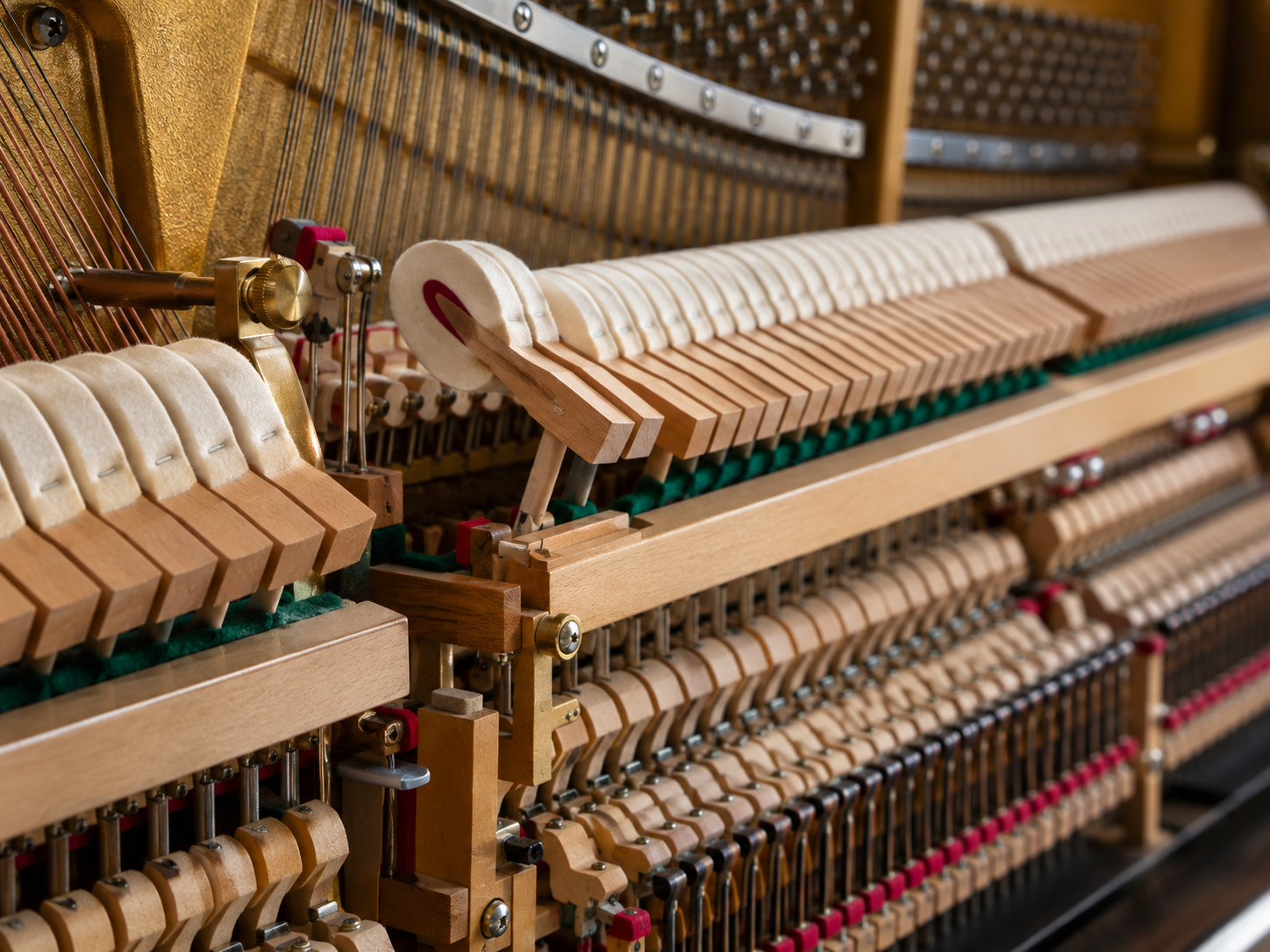
The technician checks the movement of each key, key travel, the transfer of force to the hammer, and how the key returns. The technician can then repair or regulate the specific area causing the problem. The goal is to make the keys respond more consistently so the player can control the keyboard more evenly.
If an object is trapped in the keyboard, the technician will inspect the area and remove it appropriately.
If components have been affected by humidity or deterioration, the technician will assess the necessary repair based on the actual condition.
If the overall action is still in good condition but the key response is uneven, action regulation may be considered.
What Should You Not Try to Do Yourself?
Frequently Asked Questions
Can Humidity Make Piano Keys Feel Heavy?
Yes. Humidity can affect parts involved in key movement, so the technician should consider both the symptoms and the piano's environment.
If Only a Few Keys Feel Heavy, Does the Whole Piano Need Repair?
Not necessarily. Sometimes the problem is limited to a specific area, but the overall action should still be inspected to see whether similar problems may be developing in other keys.
Do I Need to Send Photos or a Video?
Photos or video can be sent if convenient, but they are not required. The cause, repair items, repair approach, cost, and repair time can only be confirmed after the technician has inspected the actual piano on site.
Contact the Team to Arrange a Piano Inspection
Describing the symptoms by phone helps the team arrange an appropriate appointment. However, the repair list, repair approach, cost, and repair time can only be confirmed after the technician has inspected the piano on site and reported the findings to the team for a quotation.
Service Areas
For customers in the main service areas and nearby provinces — Bangkok, Chiang Mai, Phuket, and Khon Kaen — the team can check available service appointments when you contact us.
For locations outside the main service areas, customers can contact the team so we can check travel feasibility and appointment availability. Service depends on the route and the team's travel schedule at that time.
Related Articles
Why Do Piano Keys Stick, Respond Slowly, or Fail to Return?
Learn about sticking keys, slow key return, and abnormal key response, including what you should avoid trying to repair yourself.
Is Your Piano Out of Tune, or Does It Need Repair?
See how to tell whether the problem is mainly related to tuning or whether the piano should be inspected for mechanical repair first.
How Often Should You Tune a Piano?
Learn when a piano should be tuned and when sticking, stiff, or abnormal keys may indicate that mechanical inspection is also needed.
A Piano Has Not Been Played for Years — What Should Be Checked?
Useful for pianos that have been unused for a long time and may have stiff keys, humidity-related issues, or mechanical problems.
Grand Piano With 2 Pedals vs 3 Pedals: What Is the Difference?
Understand the functions of the Damper, Soft, and Sostenuto pedals, including cases where pedal problems may occur together with mechanical issues.
Heavy, Stiff, or Uneven Piano Keys?
Tell the Churairat Music team about the symptoms, piano brand, model, serial number, and location so we can arrange for a technician to inspect the actual piano and assess the most appropriate repair or regulation approach.
Contact Us via LINE